
Collaboration with fishers yields dolphin stranding and bycatch data in Cote D’Ivoire
Cote D’Ivoire is located in the middle of the Atlantic humpback dolphin’s (AHD) range, and confirmed records of the species are available from countries nearby, such as Benin, Togo, and Sierra Leone. However, the species has never been documented, either live or dead in the country. While extensive research has been conducted on cetacean bycatch in Ghana, very little data is available on cetaceans in Cote D’Ivoire, and it is not known whether the lack of AHD records reflects a true gap in the species’ distribution or a lack of survey effort. In 2024, CCAHD Partner CEM (Conservation des Espèces Marines) began documenting turtle, shark and ray landings in Grand Bereby. They quickly noticed that there were an alarming number of dolphin carcasses in amongst these other species, and alerted the CCAHD. Support was found for an 8-month trial programme, during which CEM staff documented all the dolphin bycatch and stranding observations at fish landing sites in Grand Bereby as well as bycatch occurring at sea on vessels where fishermen trained by the CEM team used their phones to take photos and videos of carcasses, as well as a few live sightings.
Between August 2024 and March 2025, CEM focal point Eric Quayson, compiled 31 cetacean records in an online database with links to Google Drive folders containing the relevant photos and videos. In cases where species identifications were challenging, due to poor angles or decomposition, CCAHD partner, Dr. Thomas Jefferson, was consulted to provide his expert opinion. In June 2025, the CEM team hosted collaborating fishermen for a feedback and awards ceremony, during which fishers were given a presentation compiling all the valuable data they had contributed, and key informants were rewarded with smart-phones and other prizes to encourage them to continue reporting more sightings.

Honouring the fishers whose reports are shaping marine conservation. Key contributors received smartphones and tokens of appreciation.
Although the records compiled to date do not include any AHD, and seem to be mostly species expected to occur further offshore where the driftnet fisheries operate, the CCAHD is working with CEM to identify additional sources of funding that will allow this valuable project to continue. In addition to working with fishers to collect valuable data, the team plans to engage in more community outreach and education to make fishers aware of the valuable role that cetaceans play in maintaining healthy marine ecosystems. This will, in turn, create enabling conditions for future projects to try and introduce more selective fishing practices less likely to lead to bycatch.
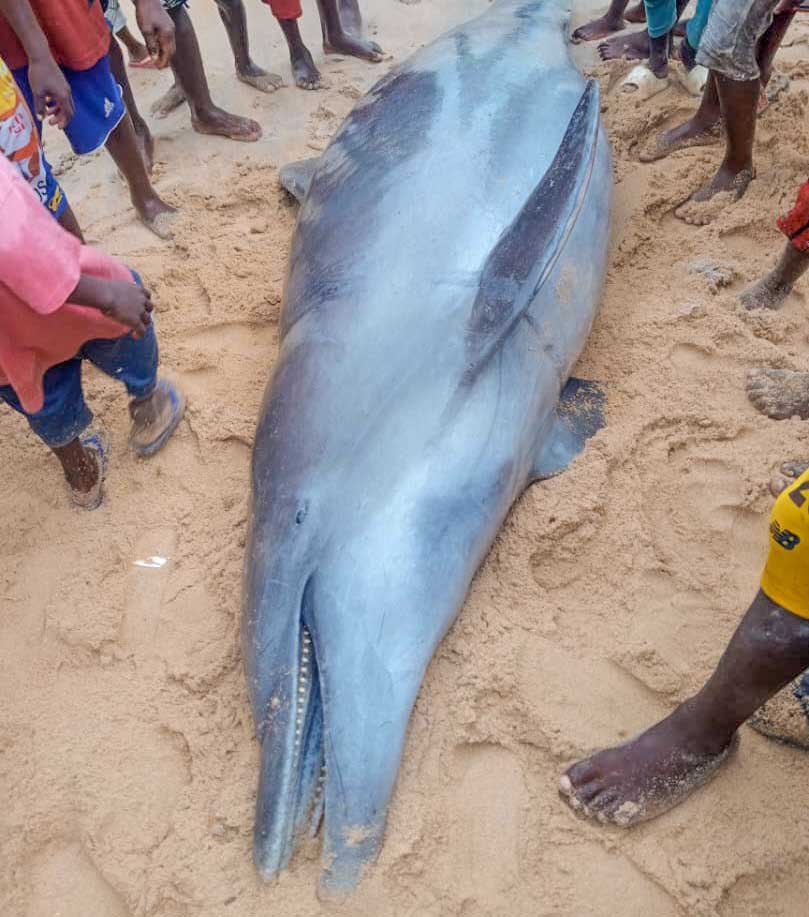
Bottlenose dolphin (Tursiops truncatus) documented as bycatch near Grand Bereby, Cote D’Ivoire.