
AMCO and Partners Launch Landmark Transboundary Marine Conservation Project in Cameroon and Equatorial Guinea
The African Marine Conservation Organisation (AMCO) and its partners have officially launched a four-year initiative that will strengthen marine conservation across the shared coastal landscape of Cameroon and Equatorial Guinea. The project is titled Support Project for Participatory Marine Conservation and Adaptation for Oceans (Pro-CAMPO).
Funded by the European Union, the project was launched on 8 June 2026 in Campo, Cameroon, and 10 June 2026 in Río Campo, Equatorial Guinea. It is being implemented by AMCO, the World Wide Fund for Nature (WWF), TUBE AWU, and the Asociación Nacional para la Defensa y Gestión del Medio Ambiente (ANDEGE).
The initiative aims to establish the foundations for the long-term conservation of the natural capital and biodiversity of the Campo marine and coastal landscape by strengthening the management of the Manyange na Elombo-Campo Marine National Park in Cameroon and the Río Campo National Park in Equatorial Guinea. It will also deepen transboundary cooperation, strengthen the resilience of local and Indigenous communities to climate change, and build the capacities of institutions responsible for managing these protected areas.

Maps of Manyange na Elombo-Campo Marine National Park in Cameroon and the Río Campo National Park in Equatorial Guinea of, respectively.
Speaking during the launch in Río Campo, Dr. Aristide Takoukam Kamla, President and Founder of AMCO, underscored the importance of working across borders to protect a shared ocean.
“The waves do not ask for a visa and marine species do not recognise borders.”For the European Union, Pro-CAMPO represents an investment in both nature and people.
“Protecting the oceans is a priority for the European Union because the ocean is at the heart of climate resilience, food security, and the livelihoods of millions of people,” said Raymond Lataste, representative of the European Union.
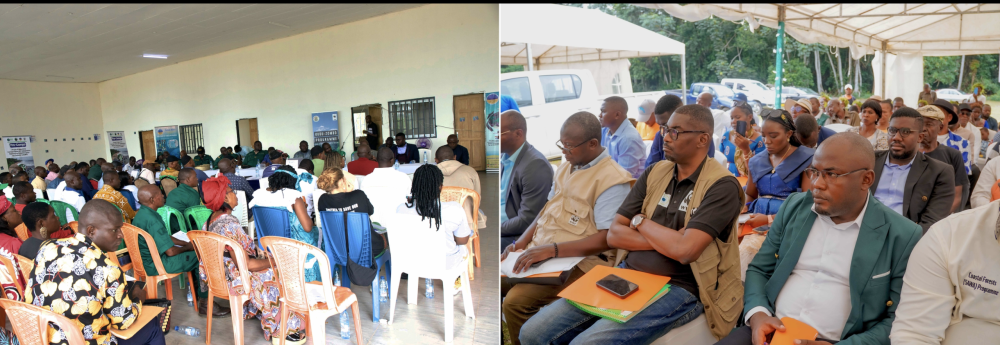
Stakeholders at the launch event in Cameroon and Equatorial Guinea, respectively
The urgency of the project is reflected in the experiences of local communities. Ursula Molende Matomba, a 67-year-old fish trader from Río Campo, says fish have become increasingly scarce.
“I have been selling fish for nearly 50 years. Today, it’s becoming harder and harder to find fish. Most of the time, the fishermen return with their canoes empty.”
In Campo, Epengo Mbipite, who leads an artisanal fishers’ association, faces similar challenges.
“Sometimes industrial trawlers destroy our nets, even though we do not fish in their designated fishing grounds.”

Community members from both Cameroon and Equatorial Guinea celebrated the launch of the project with vibrant traditional dances
For Ndounteng Ndjamo Rodric Xavier, Coordinator of TUBE AWU, these are precisely the challenges Pro-CAMPO seeks to address. Through its long-standing work around the Manyange na Elombo-Campo Marine National Park, TUBE AWU has supported coastal communities to improve their livelihoods while advancing marine conservation. Under Pro-CAMPO, the organisation will continue promoting sustainable livelihood opportunities that reduce pressure on marine resources.
As implementation begins, Dr. Aristide affirmed, Pro-CAMPO will work with governments, conservation organisations and local communities to restore coastal ecosystems, strengthen marine protected areas and promote sustainable livelihoods. More importantly, it seeks to demonstrate that protecting a shared ocean requires more than healthy ecosystems—it requires trust, cooperation and a shared commitment from both nations to conserve one of Central Africa’s most valuable marine landscapes for generations to come.