
Collaboration in Congo- CCAHD partners come together for multiple trainings, research and outreach
2026 is off to a great start for CCAHD! From January 5th-21st, multiple CCAHD partners from Congo and beyond collaborated on a Bycatch Risk Assessment, a national marine mammal symposium, a field-based evaluation of the feasibility of bycatch mitigation trials, boat-based survey training, and sharing of CCAHD outreach and education materials for work with coastal communities. The work was supported by funding from the International Whaling Commission (IWC), the Georgia Aquarium and Nuremberg Zoo and hosted by CCAHD partners Renatura and Noé in Congo.
Between January 5th and 12th, IWC Bycatch Expert Panel member Dr. Ellen Hines and Fernanda Barilari led a week-long training session using the Bycatch Risk Assessment (ByRA) toolbox to examine the overlap between Atlantic humpback dolphin distribution and fishing effort in Congo. Participants from Renatura Congo, the research and conservation team from Noé, who run Conkouati-Douli National Park, and the Wildlife Conservation Society, Congo, all contributed data that they had collected on dolphins and fisheries in Congo, building on earlier work conducted by WCS and Exeter University. The workshop was supported by three additional members of the IWC Bycatch Expert Panel, Sarah Dolman (who also convenes the CCAHD Bycatch Working Group), Tim Collins (who lived and worked in Congo for 8 years), and Dr. Federico Sucunza, who has led successful bycatch mitigation trials with artisanal fisheries in Brazil.
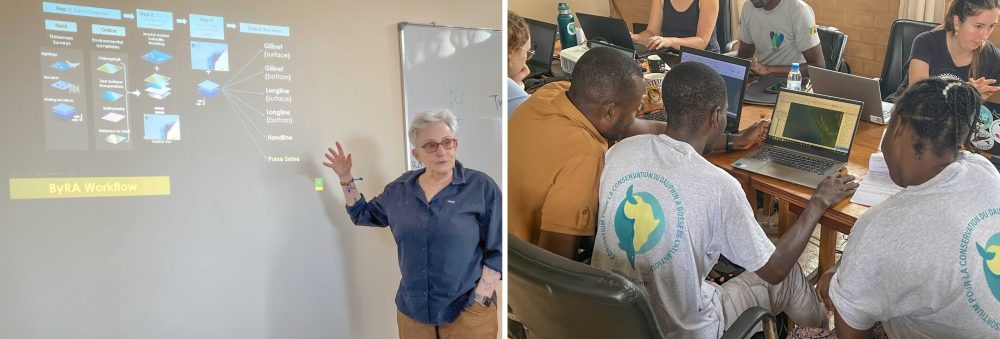
Left: Dr. Ellen Hines presenting the Bycatch Risk Assessment (ByRA) toolbox. Right: Congolese CCAHD partners from Renatura, Noé, and WCS work apply the Bycatch Risk Assessment toolbox to data on Atlantic humpback dolphin distributions and fisheries in Congo’s coastal waters.
During the ByRA workshop, a series of presentations and demonstrations on the ByRA tool were followed up with practice exercises to familiarize participants with the tailor-made GIS/mapping-based tool-box software. Teams then used their own data to generate bycatch risk maps and exposure and consequence plots for two main study areas in Congo – the coastal waters of the Conkouati-Douli National Park, and the rest of the coast outside the park. Final products, while preliminary, all demonstrated the very high level of risk posed by artisanal fisheries to Critically Endangered Atlantic humpback dolphins (Sousa teuszii) along Congo’s entire coastline. Teams’ final presentations included recommendations to further refine risk assessments using existing datasets and to continue systematic data collection on dolphin distribution and fishing effort to improve future bycatch risk models.
On Friday, January 9th, Renatura convened the second National Marine Mammal Symposium, hosted at the Institute Français de Congo. Attended by over 40 participants representing government agencies, NGOs, schools, fishing associations and industry, the symposium included inspiring presentations from Congolese and international CCAHD partners, and lively panel discussions with audience participation.
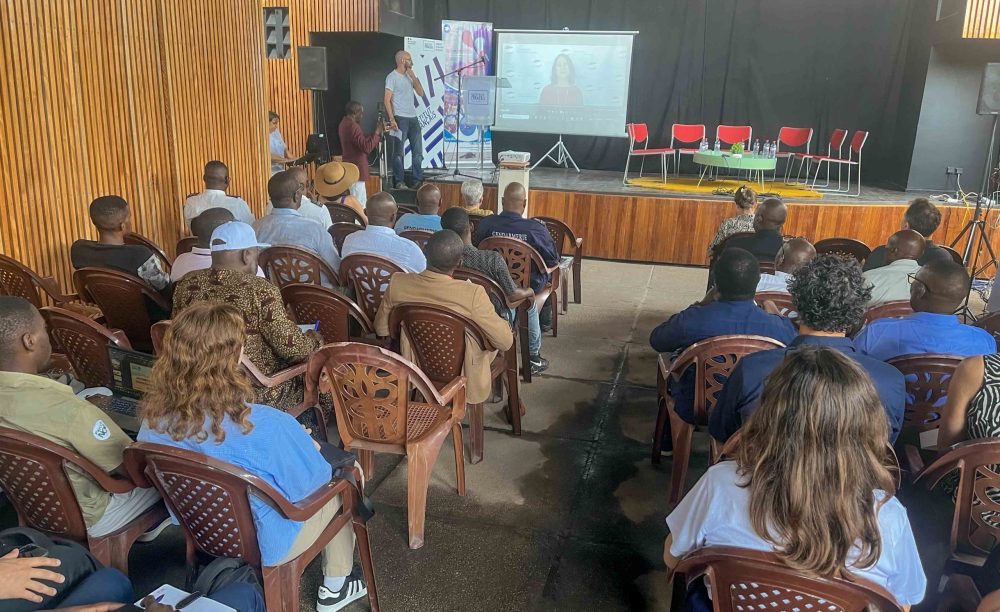
The Second National Marine Mammal Symposium, held at the French Inistiute in Pointe Noire on January 9th.
From January 13th-16th, Rentaura organised a series of visits to fishing communities in Pointe Noire and Bellelo, where Federico Sucunza worked with fishers to explore the feasibility of using a low-cost and innovative technique to reduce bycatch in artisanal gillnets. His work in Brazil proved that attaching empty plastic bottles to bottom-set gillnets could significantly reduce bycatch of Franciscana dolphins, presumably because it increases the dolphins’ ability to detect the nets using their echolocation, and thus avoid swimming into them. Discussions and demonstrations with fishers will help Renatura determine how to setup similar trials in Congo.

Left: Discussing bycatch mitigation with fishers in Pointe Noire. Right: Dr. Federico Sucunza explains to Congolese fishers how attaching empty plastic bottles to bottom-set gillnets helped to reduce Franciscana dolphin bycatch in Brazil.
On January 15th, CCAHD Coordinator, Gianna Minton, traveled to Conkouati-Douli National Park , where Noé hosted a 4-day training course on boat-based survey methodology and data collection from stranded dolphins. Noé also hosted 2 trainees from Renatura and one from WCS, providing accommodation, transport and a boat and fuel for coastal surveys. A combination of classroom-based and hands-on training included 2 days conducting transects along the coast of the park (3 days were planned but heavy rains prevented surveys on the second day).

Participants from all 3 Congolese NGOs spent 4 days undergoing training in boat-based cetacean survey methodology and data collection from strandings.
Finally, thanks to funding from the Georgia Aquarium, the CCAHD was also able to share over 120 Keita and the Dolphin children’s books with the Conkouati Park Outreach and Education team to support their work with children and schools in the park, and to discuss possible future collaboration with the Jane Goodall Institute, who have an extensive outreach and education programme in schools throughout Congo.

120 copies of the Children’s book, Keita and the Dolphins were shared with the Conkouati-Douli National park for their outreach and education activities in communities throughout the park.
By combining resources and expertise, CCAHD partners have provided a huge boost to Atlantic humpback dolphin and marine megafauna conservation in Congo. Team members consolidated their partnerships and friendships, which are sure to foster even more collaboration and synergy in the coming months and years. Watch this space!